
FLAT IS THE NEW BLACK
FEBRUARY 19, BARCELONA

Share with your team
A New Year & A New Consumer: How Beta Babies Will Change Everything
2025 sees the birth of an entire new consumer generation. The Beta generation babies born today will be the CEO and world leaders of tomorrow by 2075.
For the first time ever, we have seven generations of consumers coexisting. For brands and business owners, this presents a unique challenge and opportunity. It means navigating seven distinct consumer value sets and understanding seven unique perspectives through which to approach and engage your target market.
With the addition of a new generation, it’s worth taking a moment to reflect on the formative influences that shaped the previous six generations.
Understanding the Values of Previous Generations of Consumers
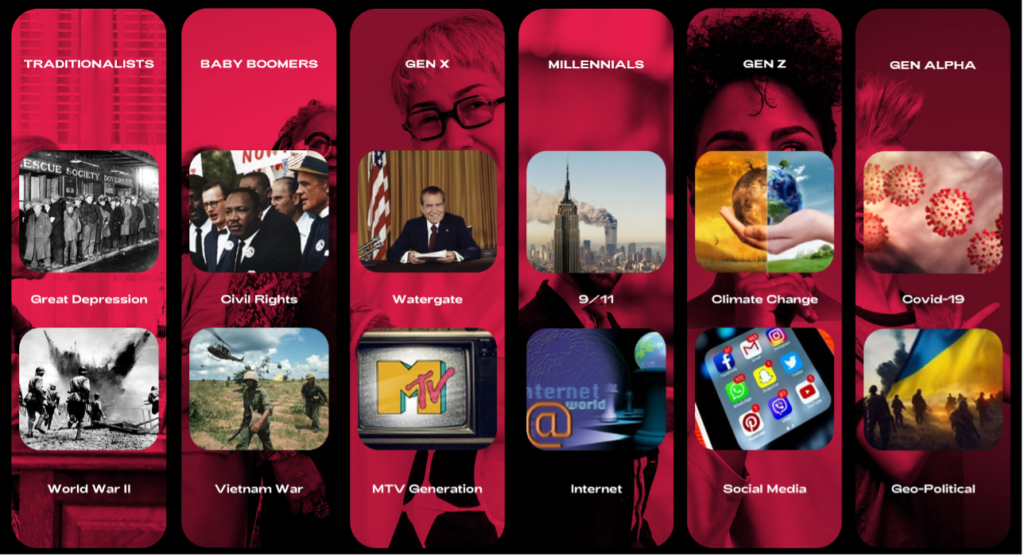
Traditionalists (born 1928-1945) grew up in a largely manual world and experienced the gradual emergence of automation during the 1950s and 1960s. For instance, by 1949, only 45% of U.S. homes had a domestic refrigerator.

Baby Boomer consumers (born 1946-1964) came of age during a post-war economic boom, characterized by mass production and a culture of material prosperity. This generation embraced TVs, cars, and symbols of success, living in an analog world powered by wired telephony, radio waves, and vinyl record players.
Generation X (born 1965 – 1980) were the pioneers of low-tech consumerism. They witnessed the infancy of home computing, the rise of video game consoles, and the popularity of the Sony Walkman, all while immersing themselves in the revolutionary MTV culture.

Millennials (Gen Y, born 1981-1994) were the first generation to experience the digital world we recognize today. However, most transitioned from a low-tech reality to digital during their late teen years. As a transformative generation, they straddled both worlds, with one foot in the analog past and the other in the digital future. Often dubbed the “white-wire generation,” their era was defined by iPods, iTunes, and iPhones, which catalyzed profound change.
Generation Z (born 1995-2009) became our first truly digitally native generation, growing up fully immersed in the digital world. For Gen Z, digital is part of their DNA. They are the app-based generation, consuming through platforms like Spotify, YouTube, Snapchat, and TikTok.
Generation Alpha (born 2010-2024) represents the streaming generation, born to Millennial parents. They are growing up in an era of augmented reality (AR), virtual reality (VR), and AI assistants like Alexa. As teens, they are maturing alongside AI and are profoundly shaped by algorithms. Dubbed the “stroller scrollers,” many had a device in their hands before they could even walk.
Generation Beta: The First Fully AI-Enabled Generation
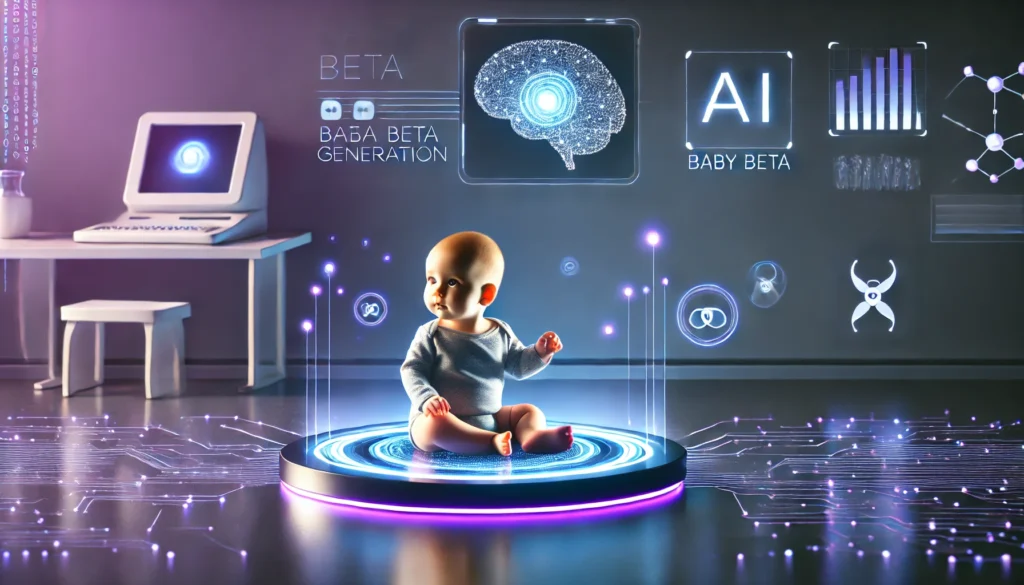
That brings us to Generation Beta (born 2025-2039) and what they are likely to become. They will be the first fully AI-enabled generation, growing up in tandem with and at the pace of advancing technologies. Their worldview and experiences may be fundamentally different from those of their Millennial and Gen Z predecessors—perhaps as distinct as the digital transformation Millennials underwent compared to the analog world of their Baby Boomer parents. Each generation’s values are shaped not only by technological advancements but also by their unique social, political, economic, and cultural exposures.
The old ways of working, the old ways of doing business, are significantly less relevant to the new generations. They are as irrelevant as cassette tapes and floppy disks, a novelty at best.
The new consumer demands to be correctly placed at the centre of everything, that Blue Dot Consumer just like Google maps, everything always shown from their perspective. They demand convenience, instant, authenticity, and personal brand experiences. But how will these new Beta babies differ? How will our organisations and brands need to change to meet their future needs?

Moore’s Law: Driving Exponential Growth in Computing Power


Just last month at CES, Jensen Huang, CEO of Nvidia, unveiled Project Digits, the world’s smallest personal AI supercomputer, retailing at $3,000. Packed with their new GB10 chip featuring a staggering 208 billion transistors, this supercomputer can run a 200 billion parameter model—or you can network two together to tackle a 400+ billion parameter model. When we compare the processing power of today’s microchips with those from just 30 years ago (1995), it’s like asking a child to run alongside a SpaceX rocket and keep pace.
No matter how fast you think our digital society and AI development is moving in 2024, Generation Beta is strapping in for a ride that will make today’s advances look slow in comparison. And this is all before we even begin to explore the possibilities of Quantum Computing.

In recent testing, Google’s quantum chip performed a computation in just 5 minutes that would take one of today’s fastest supercomputers 10 septillion years (that’s 10^25—thousands of billions of years, a number that far exceeds the age of our known universe). So, what does all this talk of 208 billion transistors and quantum computing mean for Beta babies, you might ask? It means that the world is about to experience a technological step-change—and that will ripple out socially and culturally as well. The AI outputs we see today—deepfake videos, avatars, metaverse environments, and ChatGPT capabilities—are just the beginning.

The Accelerating Impact of Climate Change: A Crisis We Can’t Ignore
The impact climate change is having on our daily lives has accelerated significantly over the last number of years. Floods, fires, critically damaged fish populations in our oceans, rainforests being continued to be ravaged for feeding an ever-expanding global population, melting ice caps.

The impact climate change is having on our daily lives has accelerated significantly over the last number of years. Floods, fires, critically damaged fish populations in our oceans, rainforests being continued to be ravaged for feeding an ever-expanding global population, melting ice caps.
We don’t need to go over the scientific data. We are all intelligent leaders and executives. Since the Industrial Revolution, the amount of CO2 in our atmosphere continues to rise, put there by our own actions. Industry, Energy, Transport and Agriculture are collectively responsible for the increase in global temperatures, the death of our oceans, and the depletion of our natural resources, and we continue to destroy.

The predictions by 2075 are that we will have experienced a 3–5-degree temperature increase, enough to cause significant planetary harm. So we are to hand the Beta generation of leaders a broken future.
Possibly.
Probably.
Definitely.
The Unsustainable Pursuit of Growth

Every brand and business wants to grow. But why? Do we ever ask why? Growth is what is causing the problem.
‘Growth for the sake of growth is the ideology of a cancer cell’ said ecological philosopher Edward Abbey. The tumour that is modern capitalism and its growth KPI needs to be treated.
The hypocrisy is obvious. On one hand, the sustainability agenda is everywhere. Most company annual reports have strong green-washing imagery and content. Nearly every event at which I perform will have a sustainability speaker or time allocated to debate the issue. Every corporate website demonstrates how seriously the organisation takes its sustainability responsibilities. However, at the same time these same companies push for growth, strive for expansion -more stores, more people, more markets.
You cannot have both. You see, growth is the problem, the insatiable desire to hit the G-spot. Growth at any cost, but growth is killing our planet. ‘We aim to double our sales in 5 years’ – is a common mantra I hear from companies. You cannot have ‘more’ without impact.

Redefining Success in a Finite World
Growth is an inherent part of every economic model, true of governments and nations as much as it is of organisations. Talk to any economist and they will tell you that growth is essential to improve a population’s standard of living.

The explanation goes something like this. Growth means higher GDP, which means more tax revenues. With this additional tax revenue, governments build more schools, universities, hospitals and infrastructure, which in turn help us grow further. Growth fuels growth, investment catalyses more investment, and so we continuously improve our standard of living. That is the economic argument for why growth is essential, and I think it is a valid argument in developing countries. Growth improves our standard of living. Few of us could argue against the building of schools, hospitals and road networks where there are none. The families in a rural Cameroon village, without adequate water, a road network or access to a healthcare centre don’t care about my ‘Flat is the New Black’ concept. They want growth, in fact they need it.

The Growth Delusion in the Developed World
So why does every organisation have a fundamental need to grow? Where does it come from? Ask yourself, have you ever been in a meeting where the discussion was around how to sell less, or witnessed the board saying ‘OK, that’s enough’. What is wrong with ‘steady as she goes’ as a strategy? When did ‘more is more’ become the everyday capitalist mantra? No one ever questions growth, but perhaps we should.

Since you graduated university or your MBA, growth has been expected of you as a leader. In fact, your annual review, bonus and performance is probably based on it. Shareholders certainly expect it. They want higher dividends or a better commercial performance to drive up the share price. And growth is our proxy of success. But what if the shareholders are wrong too? Things change over time, and I think our commercial growth expectations might need to be one of them.
Morally and socially, what was once acceptable, later becomes shameful. In the 1950s it was socially acceptable to ask a black person to sit in a designated seat on a bus, partitioned from those of Caucasian ethnicity. Try that today and they’d rightly tell you where to go. Today it is baffling to even think how such a norm existed, but it was an everyday occurrence back then. In the 1970s & 1980s children were often name-called as ‘gay’ in the playground as a slur. Again, that would not happen today. In the 1990s, there were many sit-coms and comedy sketch shows poking fun at the Transgender community. Those shows would not air today. Things that were once socially acceptable become less so over time. Social morality is an ever-evolving reality.
The Uncomfortable Truth of Endless Growth

You walk down a side street in Hanoi or Chiang Mai today and you wonder what the Burger King is doing there. Was there an overwhelming consumer need in the Thai or Vietnamese populations for a Whopper, or did the company seek expansion, pushing into new markets to feed the growth monster, bringing the delights of obesity and processed foods to ever new populations.
You enjoy your holiday espresso on the balcony of your hotel, watching as another two luxury hotels are being built opposite you. Do we need more hotels, more linen to wash, more tiny shampoo bottles to dispose of everyday? Everywhere you look there is more. New variants, new flavours, new stores.
As climate change starts to have a significant effect on our everyday lives, moving from a conceptual to an actual threat, the sustainability debate moves from a CSR one to a survival one. Most companies’ purpose is still profit, with a capital ‘P’. Maximise revenue, maximise sales, maximise profits. It would take a brave board member to suggest ‘flat’ as the new KPI.

When ‘Flat’ is the New KPI
So here is the very simple question: If a company is profitable at its current size and scale, why then is their focus to grow? To do more damage to the planet. To build more factories and stores, to send more parcels, to put more trucks on the road? Why are we intent on growing knowing that it is damaging the planet? When will a CEO stand-up and say ‘enough’? When will the sustainability agenda outweigh the growth one? Who will take the first stand?

Of course, a certain amount of growth and scale is required to reach a profitable point. But assuming that has been reached, that we have covered costs and made some profit, we need to stop. Growth has become an unquestioned objective, and we are drifting into morally questionable territory. I envisage a future boardroom conversation falling silent as someone utters the dirty G-word, the other executives embarrassed that someone would suggest the company would want to actively contribute to killing the planet.
Flat is the New Black
A future where the next generation of shareholders are not motivated by financial reward but more by investments that help us maintain life on this planet. Maybe then, growth will become as uncomfortable as calling someone ‘gay’ in the playground or asking a black person to take a certain seat on a bus. Something morally wrong and socially unacceptable. Perhaps the Beta shareholders will want an ROI around ‘planetary survival’ and not a financial one?

Edward Smith, the captain of the Titanic is billed a hero, proudly going down with the ship he captained. But he was the same man who ordered the progression of the ship through a dangerous icefield, at near full speed, at night, having received countless telegrams that day from other ships having passed through that same ocean of dangers. He kept his hand on the throttle. Perhaps he went down with the ship in shame, not pride.
There are more business leaders and CEOs in the world than there are politicians and regulators. Stop hiding behind the politics of climate change. The actions of all of our collective industry organisations have more impact on the world than any policy maker.
You are the captain, a leader. You have your hand on your organization’s throttle. Are you going to be responsible for our collective sinking? Or are you going to acknowledge the dangers, realise that slower is what is needed, and respect the environment in which you are in?
Flat is the New Black, the new sexy.
More content from Ken
For those too lazy to read blogs, and to view further visual content and past performances from Ken Hughes, check out the YouTube channel where he discusses all things consumer and customer experience related.