

In everyday interactions, trust is generally built through small signals.
For example, have you ever wondered why your airline pilot wears a military-style uniform? They could do the job just as well wearing jeans and a hoodie, but the hat and stripes signal authority, control and discipline.

Staying with airlines, the airline cabin crew are immaculate for a reason. Crisp uniforms, polished shoes, composed posture and perfect hair are not just random aesthetic choices; they are visual reassurance cues.
They signal order, competence and control. Most passengers are not aeronautical engineers, and we have no way of assessing the mechanics beneath our feet. We want to trust that this large metal tube won’t fall out of the sky and take us with it, so we rely on cues. If everything appears calm and precise above deck, we unconsciously infer that everything is functioning properly below deck too. It is a subtle but powerful transfer of trust.
The bank branches of old had elaborate counters, marble floors and oak panelling to convey wealth and permanence. The signal was ‘you can trust us with your money. We will always be here’.

Apple’s meticulous store design similarly signals competence and control, and their over-staffing is a clear signal that should anything go wrong, the support and care you will need will be there for you. Even hospitals often dial-up that detergent smell at the entrance to signal hygiene.
Some trust signals have very little practical function at all. Take the “Your room has been cleaned and sanitised for your protection” door seals that appeared in hotels during the pandemic.
Rationally, rooms were always cleaned before a new guest arrived. Housekeeping finishes, leaves, and the next person to enter is you. The seal did not fundamentally change the hygiene process. But it served as a signal. A visible cue that safety had been considered. In uncertain times, the sticker offered reassurance. It gave you something to see, a seal to break, something to believe, and that belief reduced anxiety.

Why Loyalty Begins with Trust
While signals are key, brand trust rarely hinges on a single dramatic moment. It usually accumulates through consistent micro-experiences. And over time, these experiences shape our belief.
In modern marketing, loyalty is often treated as a reward mechanism. Collect the points and claim your perks. The discounts and tiered memberships are offered in the hope that customers will not only stick around but continue to give up their valuable data. The problem with this is that loyalty does not begin with incentives. It begins with trust.

Trust is possibly one of the most overused words in business language. Every brand claims to value it but few seem to truly understand how it works. Fewer still design for it intentionally. Yet without trust, no amount of Customer Experience (CX) design or emotional storytelling will create durable emotive loyalty.
At its core, trust is about vulnerability. When a customer chooses your brand, they are taking a small psychological risk. They are believing that you will not waste their money, their time, and that your product or service will not embarrass them socially, that you will not mishandle their data, or fail them when it matters. Trust reduces perceived risk. And every purchase decision, sometimes unconsciously, contains some form of risk.

From a psychological perspective, trust simplifies our decision-making. When trust is high, our cognitive load drops. We don’t need to think about it. It is why you buy the same brand of cereal or frequent the same café. The familiar is easy. Customers do not need to scan for alternatives. They stop hedging their bets. They move from evaluating alternatives to simple belief. ‘This one is good’.
But the opposite is true when trust is low. That is when friction rises. Customers then hesitate; they compare, delay and second-guess. This is when we lose customers, when other alternatives are considered.
Trust, therefore, is not some soft and fluffy concept. It is an absolute commercial accelerator. Get it right and you lock a customer in. Lose it and you are wide open to market share loss.

The Psychology and Neuroscience of Trust
Neuroscience research also shows that oxytocin, often referred to as the bonding hormone, plays a role in building trust and cooperation. When humans feel cared for, listened to, or supported, oxytocin levels rise. At the same time, breaches of trust activate threat responses in the brain, increasing cortisol and triggering vigilance.
When a brand “lets us down,” the reaction is not purely rational but physiological. The emotional sting of disappointment can linger far longer than the functional inconvenience that caused it. Think of the insurance company that deny your claim or pay less than you deem fair. Maybe you paid the premiums for 20+ years and correctly trusted them to be there for you when you needed them. But if when that time comes, they put their profits before their promise, then they instantly lose your trust, respect and business. It is a customer interaction charged with emotion.
Belief, Behaviour and Brand Alignment
This is why trust and belief are so closely intertwined. Belief is not about data alone. It is about narrative alignment.

Customers believe brands whose actions consistently reinforce their stated values. Nike’s alignment with cultural movements, or Lego’s commitment to creativity and co-creation are not random campaigns. They are coherent narratives expressed through action. When belief and behaviour match, trust deepens. When they diverge, trust erodes quickly.
Human relationship theory also offers clearer insight. In personal relationships, trust grows through reliability, responsiveness and care. When those elements are missing, emotional withdrawal begins. The same applies to brands.

A single meaningful breach can overshadow years of steady performance, just as in personal relationships. It can take just one bad haircut to never visit your usual salon again. Trust takes time to build but can be destabilised quickly.
The Trust Tower
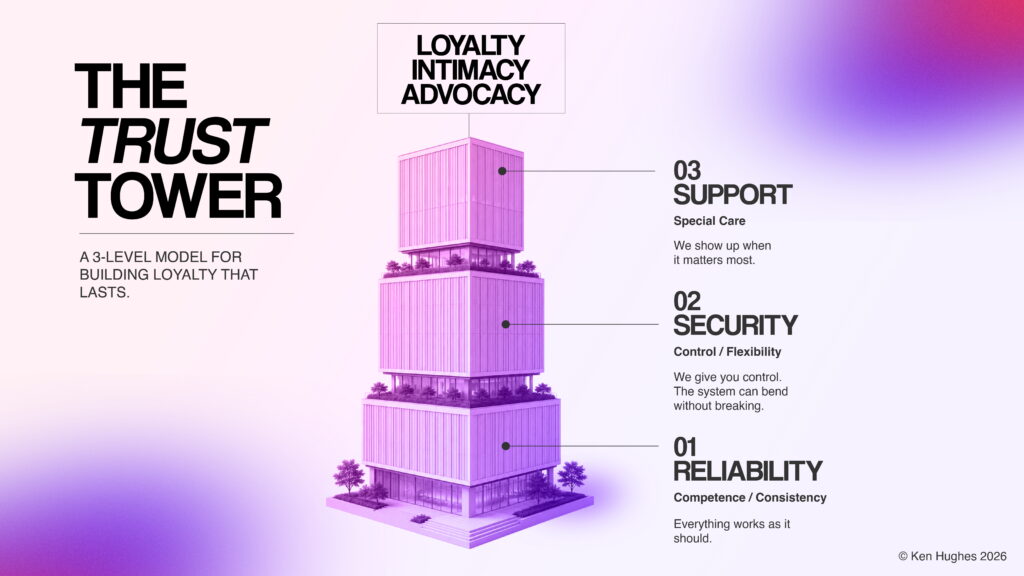
To understand how trust operates and builds in business, let me propose a simple framework called the Trust Tower. It consists of three levels: Reliability, Security and Support. Each level builds on the previous one, and your brand must climb the tower in order.
Level One: Reliability
The foundation of the Trust Tower is Reliability. This is where competence lives. Products work as promised. Services are delivered consistently.
Processes are predictable. Amazon built its early dominance on reliability. Orders arrived when expected, returns were processed efficiently and systems functioned smoothly. Toyota established loyalty through mechanical dependability. In hospitality, Marriott’s global consistency ensures that customers know what to expect wherever they travel.
Reliability reduces anxiety. It creates confidence. However, it does not yet create emotional attachment. It prevents dissatisfaction rather than inspiring devotion.
Level Two: Security
The second level is Security. Here trust becomes deeper and more psychological. Security is about flexibility and control. Customers need to know that the system can adapt when life does not go according to plan.

During the pandemic, banks that offered flexibility on mortgage payments strengthened trust because they signalled understanding. Netflix allows easy cancellation without interrogation. One of the weakest aspects of AirBnB is the inflexibility and cost of cancellation, something that Booking.com have mastered. If a customer feels trapped, they are less likely to feel secure.
When customers feel that policies can bend without breaking, they experience a sense of safety. Security reassures them that they will not be punished for circumstances beyond their control.

Level Three: Support
The highest level of the Trust Tower is Support. This is where emotional loyalty is fostered. Support is compassion in action. It is what happens when a brand alleviates customer suffering rather than merely enforcing policy.
Southwest Airlines has become known for going out of its way to help passengers during personal crises. The Ritz-Carlton empowers employees with discretionary budgets so they can solve guest problems creatively and generously. Chewy, the pet supply retailer, sends handwritten condolence cards and flowers to customers whose pets have passed away.
These gestures transcend transaction. They communicate care. When a company shows up in moments of vulnerability, trust transforms into attachment.
Trust at this level then creates advocacy. Customers remember how they were treated when it mattered most. Emotional memory is powerful, and it influences future decisions more than rational analysis.

Trust also operates internally within an organisation. The Employee Trust Tower mirrors customer trust.
At the base level, employees need reliability in pay, process and communication. At the second level, they need psychological safety and flexibility. And at the highest level, they need support during personal challenges and meaningful investment in their growth.
When employees feel trusted and supported, they extend that same posture outward. Customer trust and employee trust are interconnected systems.
Climbing the Trust Tower
All of this is important as we are living in a period of heightened scepticism. Data privacy concerns, AI-driven automation and corporate scandals have increased consumer vigilance. In uncertain environments, people tend to gravitate toward trusted anchors. Brands that deliberately design for trust will thrive but those that treat it as incidental may struggle.

Trust is not a marketing tactic or brand noise. It is a relational contract. When customers trust you, they stop calculating constantly. They move from guarded engagement to belief. Belief becomes loyalty, and loyalty, when emotional, then becomes advocacy.
To build lasting loyalty, organisations must climb the Trust Tower intentionally. Establish reliability, reinforce security and demonstrate genuine support. When trust becomes emotional rather than transactional, customers do not simply stay. They commit.
Have a think about what trust signals you are currently sending your customers and on what level of the Trust Tower you are operating. Does everything align?
Remember, trust is built in moments of consistency and broken in moments of contradiction.