
Connection is Everything.
It is the title of most of my keynote performances today and a powerful reminder that brands need to foster genuine emotional connection with their customers to build the loyalty they seek.
But the deeper I look across science, philosophy, and nature, the more I realise that connection is not just a metaphor but is one of the most fundamental principles of our reality.
In fact, it is separation that is the illusion.
Nowhere is this more beautifully illustrated than in the strange world of Quantum Mechanics.

Deep inside the physics of the universe lies a phenomenon that challenges one of our most basic assumptions: the idea that things exist independently of each other. The phenomenon is called Quantum Entanglement.
And it has profound implications, not just for science and our understanding of the universe, but also for how your brand should rethink your relationship with your customers.
So, let’s dive into quantum theory, quantum computing and then pop out the other side to learn what this all might mean for your brand and business to optimise your Customer Experience (CX) and win the Race for Relevance with your customers.
The Quantum Universe: We are More Connected Than We Think
Quantum mechanics studies the behaviour of the smallest particles in the universe, namely particles, electrons, and photons. At this level, reality behaves in ways that feel deeply counter-intuitive.

In our everyday experience, our world behaves in ways that feel predictable. A ball will roll where you push it. A light turns on when you flip the switch. But at the particle level, the universe behaves very differently. Things become less intuitive and seem almost mysterious.
One of the strangest discoveries in quantum physics was the afore-mentioned entanglement. When two particles interact, they can become linked in such a way that their states remain forever connected, even when separated by enormous distances.
If something changes in one particle, the other particle instantly reflects that change. Even if one is in London and the other in New York. It turns out that when it comes to matter, proximity and distance can also be an illusion.
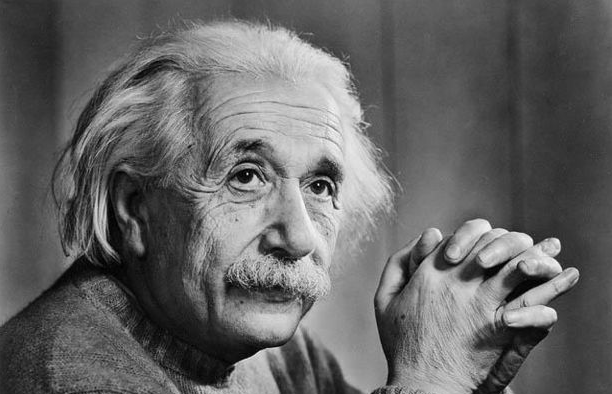
The physicist Albert Einstein famously called this ‘spooky action at a distance’, which is probably catchier than ‘quantum entanglement’ to be fair.
At its heart, quantum entanglement suggests something remarkable: the universe is far more interconnected than it appears on the surface. Particles that were once part of the same system can remain linked long after they separate, continuing to influence each other in ways that defy our usual understanding of space and time. There would seem to be other dimensions at play.
It is one of the clearest reminders that the deeper we investigate the fabric of reality, the more interconnected it all seems to become.
As I said before, it is separation that is the illusion.
Enter Quantum Computing

You’ve heard the term, but most have little idea what quantum computers are, how they work, or the impact they will have on humanity. So, here is Quantum Computing 101.
Traditional computers use bits; units of information/code that exist as either a 0 or 1. Your computer processes those bits sequentially. Add more power (more microprocessor capacity) and you increase the processing speed of the computer. But it is still reading code sequentially. 1s and 0s being read, directing subsequent action.
Quantum computers use qubits, which can exist in multiple states simultaneously thanks to a principle called Quantum superposition. Because of superposition, a quantum computer can explore many possible solutions to a problem simultaneously, rather than checking them one by one like a traditional computer.
Think of it as solving a maze. If decisions are made sequentially (will I turn right or left), there will be dead-ends, loops, until finally the sequence of your decisions will place you at the centre. But it will take time.

Now imagine at every decision-point in that maze, you can turn left and right at the same time, exploring both options in real-time. Clearly you will arrive at the centre very quickly. For every wrong move, for every dead-end you explored, you also moved in the right direction in parallel. This is how quantum processing works. The qbits determine if the code should be a 1 or 0 to suit the outcome.
Combine superposition with entanglement, and quantum computers can evaluate vast numbers of possibilities at once. This makes them uniquely powerful for solving complex problems involving huge numbers of interacting variables.
Currently IBM, Google, and Microsoft are investing billions in the race to build quantum machines. But we are not there yet. The main challenge is stability.
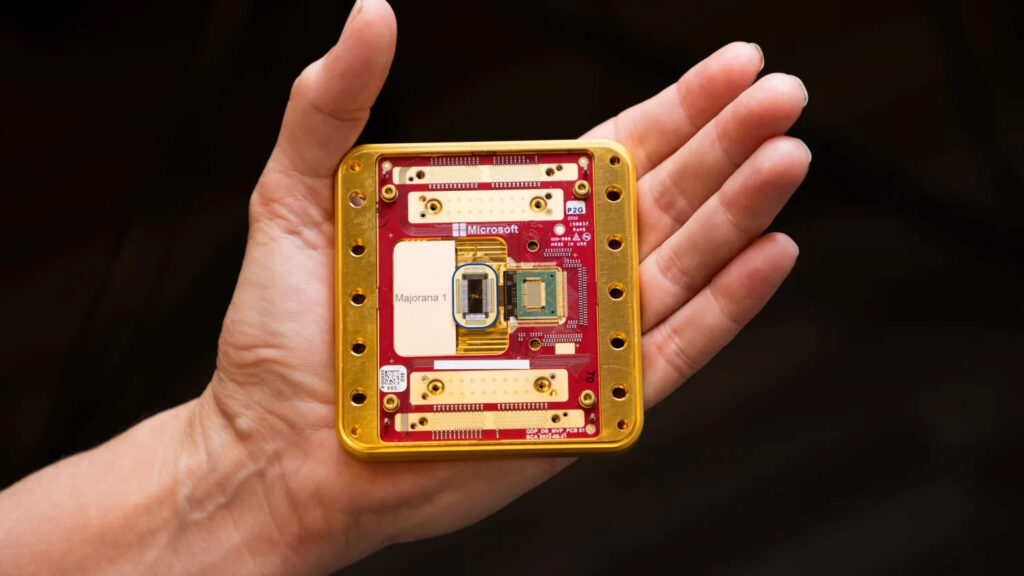
Qubits easily lose their quantum state due to tiny disturbances such as heat, electromagnetic noise, or vibrations. Because of this, current quantum computers have high error rates, roughly one error in every few hundred operations. But because of the high processing speed, these error rates multiply out quickly collapsing the calculation.
We are currently in an early hybrid quantum–classical systems stage. By the late 2020s we expect to see the first fault-tolerant quantum computers and then larger scale quantum machines in the 2030s. This will revolutionise healthcare, drug development, battery development, and of course AI.
AI powered by quantum will make our AI solutions of today look like those 64-bit gaming consoles of the 1980s. Think Amstrad and Commodore-64.

Ultimately, quantum computing will dramatically expand what humanity can calculate, discover, and design. It will be as big as electricity in terms of a spring-jump.
But that was a tangent. The deeper lesson of quantum science isn’t computational. It is philosophical. It is back to the idea that separate entities are an illusion.
The Illusion of Separation
This insight is not unique to physics.
Across religion, philosophy, and social science, the same idea appears repeatedly: that what we perceive as separate individuals are actually part of interconnected systems.
In Buddhism, the principle of Pratītyasamutpāda teaches that nothing exists independently. Everything arises through relationships with other things. In Hinduism, the philosophy of Advaita Vedanta suggests that individual selves are but expressions of a single underlying reality.

Even in Christianity, Paul the Apostle described humanity as a single organism, the metaphor of the Body of Christ, made up of many interconnected parts.
Native indigenous populations did not see themselves as separate from their environment. Modern sociology echoes the same insight. The work of George Herbert Mead shows that identity itself is socially constructed through interaction with others.
Even nature tells the same story.
Forests are connected through underground fungal networks known as the Mycorrhizal network, allowing trees to share nutrients and chemical signals. Think of the Pandora jungle in Avatar.

Zoom all the way out and even life itself evolved through ‘common descent’, meaning every species on Earth shares a common ancestor.
Across disciplines, the same pattern appears again and again. Separation is a matter of myopic perspective rather than reality.
The Illusion of Separation in Business
All of this is relevant to your organisation as in the corporate world, we behave as if the brands we own and the customers we serve exist in separate worlds. Brands believe they deliver experiences and that the customers consume/receive them.
But that model is deeply flawed.

Understanding this illusion of separation unlocks a powerful new way of thinking about your Customer Experience.
Here are five ways brands can apply the entanglement metaphor:
1. Collaboration and Co-Creation
Once you tear away the line between ‘us’ and ‘them’ you discover an entire ecosystem of cooperation and mutual benefit. Successful brands today do not see their customer as an ‘end point’ on a customer journey. If you are building loyalty, then you must approach it as a relationship.
Where can you invite your customer in? What behind-the-scenes content can you share? Are your customers involved in new product design? Do they feel co-ownership of the brand?
Adult Fans of Lego (AFOLs) design and create new products. Once a design receives 10,000+ votes inside the AFOL community, it is put forward to LEGO for review. Once in production, the original ‘customer designer’ receives 1% of all net sales revenue, alongside their credit on the box.

Puns aside, the product is built together.
Seeing your customers as a separate entity from your brand is a dangerous corporate illusion. Brands that build communities and tribal belonging set out to foster emotional entanglement.
It is an understanding that Taylor Swift built her Swiftie army upon. Emotional entanglement.
2. CX Interaction & Memory
Remember, those entangled particles influence each other regardless of distance, and similarly in your CX, every interaction shapes the emotional memory of the relationship. No matter where it occurs in the customer journey, every touchpoint is key.
An amazing CX moment in one channel is undermined if it does not equally resonate elsewhere. Excellent CX is about consistency and understanding that ‘every moment matters’.

Apple have always understood this deeply. From product design to packaging to their retail stores, every interaction is designed to reinforce a single emotional narrative: simplicity and elegance.
When there is consistency, the result is that customers approach the next interaction already positively “charged.”
The emotional relationship between brand and customer becomes entangled in terms of expectation.
CX is not a function or a task, a process or a set of metrics. It is a consistency of attention.
3. Your Employee Experience (EX) and CX are Similarly Entangled
One of the big mistakes in Experience Management is the illusion of separation in relation to EX and CX. You can never expect unmotivated, unengaged or unempowered employees to deliver outstanding customer experiences. EX influences CX.

Similarly, once you have CX tactics that are making customers feel that they ‘belong’, smile, laugh, and share your brand story with their peers, this also directly impacts Employee Satisfaction. Having happy customers makes for a happy workforce. CX influences EX.
In entangled systems, the state of one element influences the other.
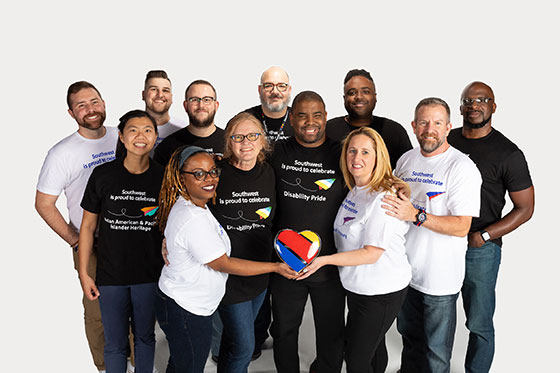
Southwest Airlines famously invests heavily in employee culture because it understands that employee experience drives the customer experience they seek. Happy employees create warmer interactions, and those interactions create loyal customers.
The system moves together.
4. Small Actions Create Deep Loyalty
At the quantum level we are dealing with the smallest particles of matter and the universe. From the building blocks of photons and electrons come atomic nuclei and then atoms (like hydrogen or oxygen), and from those atoms come molecules (H2O). Molecules are then combined to form cells, tissues, organs, organisms, materials, and on to planets and solar systems.
But it all starts with small particles, and so does loyalty and customer lifetime value.
The smallest micro-interaction can shape lifetime loyalty. A tiny emotional moment with a customer can cascade into advocacy, just like in quantum systems, tiny changes can cascade through the system
Many organisations want the big returns immediately relating to their CX. But relationships don’t work like that. And neither does the universe. We build, piece-by-piece, over time. Focusing on the small moments, the moments that matter, optimising every touch point is how you build advocacy.

The Ritz-Carlton do this very well. Their ‘mystique’ system tracks guests’ preferences across preferred room temperature, favourite drink, and pillow preference. When a guest returns, they then feel remembered.
Your favourite snack is waiting for you in your room. Staff greet you by name. It all starts to feel like you belong.
Build the customer lifetime value you seek from the foundation, block by block.
5. From Entanglement to Decoherence
Quantum decoherence is when a system loses its coherence or ‘connected state’. It is a loss of connection, when variables become separated, isolated and independent.
So, in our metaphor, entanglement is loyalty, belonging and emotional connection while decoherence is when that connection is lost, resulting in friction, indifference and customer churn.

In physics, entanglement doesn’t always ‘snap’ instantly. It breaks down over time due to changes in the environment (light, heat, measurement devices – remember those unstable quantum computers). It degrades, and so does brand advocacy.
As brand owners, we want our customers to be emotionally ‘entangled’ with our brand, but they can break that connection at any time. They can choose to walk away, or we can let the relationship degrade over time, failing to invest.
Most romantic relationships that end do not ‘snap’ but degrade over time. A failure to invest in that perfectly choreographed dance leads to disconnection. It is the same for brands.
Often with scale comes decoherence of customer relationship. Starbucks started as that beautiful ‘third place’ but quickly found itself a commodity player, losing out to more authentic community owned cafés. Pret A Manger started as a staff-led, community-driven, urban chic proposition, but lost a lot of its charm and connection when focusing on expansion. We saw the same with Shake Shack and the Hard Rock Café. High value, experiential propositions diluted through rapid expansion, operational efficiency and profit – thereby eroding charm, craft and connection.

As your brand or business scales, never take your eye off emotive meaningful connection.
The Quantum Lesson for CX
So, if quantum physics suggests that reality is far more interconnected than we once imagined, and that separation is an illusion (philosophy, religion, sociology, and ecology all echoing the same insight) then relationships are fundamental.
In business, this insight may be the most important lesson of all.
Brands and customers are not independent entities exchanging transactions. They are part of the same emotional system, with each interaction shifting the state of that system.

Each signal ripples through the relationship, each CX moment building brand advocacy.
And once a strong connection forms, something powerful happens. The brand and customer become something new together. Entangled. And therein lies the foundation for tribal belonging.
In our Agentic AI future, the brands that understand this truth will win. Customer Entanglement is our new goal.
So, in Customer Experience, just as in quantum physics – Connection is Everything.