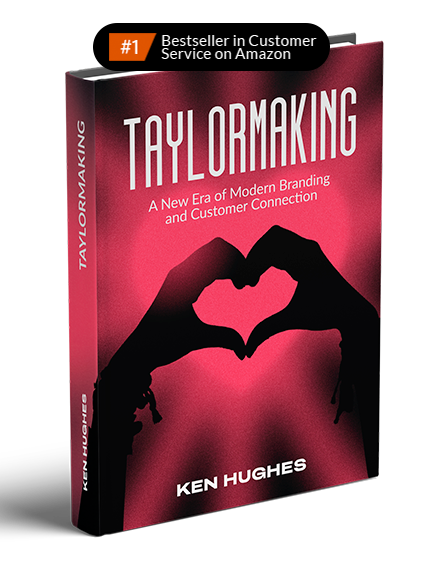

For years I have spoken about Customer Intimacy as the ultimate competitive advantage.
Not customer satisfaction. Not even customer experience. Customer intimacy.
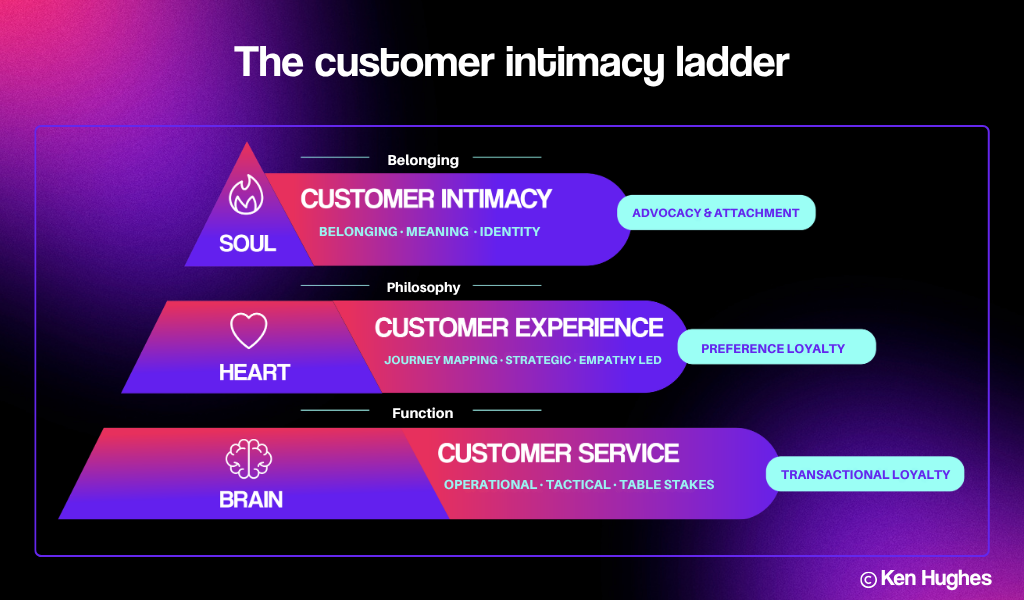
Because there is a hierarchy at play in modern business. A ladder. And most organisations are stuck on the first or second rung, wondering why loyalty feels fragile and differentiation feels impossible, even more so as AI levels the playing field.
Let me introduce you to the three tiers.
Customer Service. Customer Experience. Customer Intimacy.
Brains. Heart. Soul.
Tier 1: Customer Service – The Brains of the Operation
At the base of our ladder sits Customer Service.
Operational. Functional. Tactical.
This is the world of call centres, SLAs, ticketing systems, response times and refunds. It is departmental. It has KPIs. It has scripts. It is about fixing problems and delivering competence. It is the basics done right.

And it still matters. If you get this wrong, nothing else works.
Customer service is the brain of the operation. It ensures the machine functions. It is logical, process-driven, structured. It removes friction and resolves issues.
But let’s be honest. No one becomes a lifelong fan because you answered the phone within 30 seconds. And AI is eating this alive as competitive advantage anyway.
Customer service is now just about not disappointing people. It is table stakes, simply your ticket-to-play.

Too many organisations celebrate service metrics as if they are significant emotional achievements. They are not. They are operational hygiene. Necessary. Important. Foundational.
But they are just tactical. As I said, a ‘department’.
Tier 2: Customer Experience – The Heart of the Organisation
Move up the ladder and you enter the world of Customer Experience (CX).
CX is no longer a single service interaction. It is the sum of all interactions.
It is multi-touchpoint. Cross-functional. It maps the customer journey from awareness to advocacy. It recognises that brand perception is not shaped in one moment but in many.

Customer experience is the heart.
It pumps emotion through the system. It requires empathy, storytelling, design thinking and consistency. It understands that a brilliant sales interaction can be undone by a poor onboarding process. That a seamless digital journey must align with a human one.
CX asks bigger questions:
- What does it feel like to be our customer?
- Where are the friction points?
- Are we consistent across channels?
- Do we understand the emotional highs and lows of the journey?
This is no longer tactical. It is strategic and philosophical.
But here’s the issue. Many brands stop here.

They optimise journeys. They reduce pain points. They streamline touchpoints. They measure NPS and CSAT and think they’ve cracked it.
But customer experience, while vital, is still largely about performance. And my friends, performance alone does not create devotion.
For that, you must climb one rung higher.
Tier 3: Customer Intimacy – The Soul of the Brand
At the top of the ladder sits Customer Intimacy.

This is not a tactic or department. It is not even just a philosophy.
It is a relationship.
Customer intimacy is about belonging. Meaning. Identity. Emotional attachment. It is where tribal fandom is born. When customers don’t just transact with you but identify with you.
When they defend you online. When they wear your logo as a badge of self-expression.
When they queue overnight not because they need your product, but because they want to belong to what it represents.
This is soul.

Harley-Davidson does not sell motorcycles. It sells rebellion and brotherhood. LEGO doesn’t just sell bricks. It fosters co-creation and community – Adult Fans of LEGO design new products and share in revenue. That’s intimacy.
Taylor Swift doesn’t just release albums. She builds a fandom ecosystem where identity and belonging are front and centre.
Customer intimacy is emotional entanglement. And when you achieve it, price becomes less relevant. Competitors become background noise. Loyalty becomes resilient.
But intimacy cannot exist without the lower tiers being secure.
You cannot build belonging on broken service. You cannot build advocacy on inconsistent experiences. The ladder must be climbed in order.
The EX Parallel: Employee Intimacy
And everything I’ve just described about customers applies equally to employees.

Employee Service is HR processes, payroll accuracy, IT support. Brains.
Employee Experience (EX) is culture, leadership behaviour, workplace design, communication. Heart.
But Employee Intimacy? That’s where employees feel seen, valued and empowered. Where they believe in the mission. Where they feel psychological safety and identity alignment with the organisation.
That’s where discretionary effort lives.
And here’s the truth most organisations avoid: You cannot create customer intimacy without employee intimacy. CX and EX are entangled systems.
Unengaged employees cannot deliver emotionally resonant customer experiences.
And emotionally engaged customers create pride and purpose for employees.
The system moves together.
Brains. Heart. Soul.
On both sides of the organisation.
Why Understanding Is Not Enough
But what about the data?

We live in an era where feedback is abundant. Surveys. Listening tools. Behavioural analytics. Experience management platforms. Understanding has never been easier.
But understanding alone changes nothing. Insight without action is simply theatre.
You can map every customer pain point. You can track sentiment in real time. You can identify emotional dips in the journey. But if you do not act – if you do not redesign systems, empower teams, remove friction, personalise touchpoints and invest in emotional connection, then you remain stuck on the lower rungs.
The brands that win are not the ones who measure best. They are the ones who move best.
Experience data must become experience design. Understanding must become operational change. And that change must intentionally climb the ladder toward intimacy.
The Customer Intimacy Roadmap
So how do organisations use this three-tier model as a roadmap?
1. Secure the Brains (Customer Service & Employee Service)
Get the basics right. Reliability. Speed. Competence. Remove friction ruthlessly. Ensure operational hygiene.
2.Strengthen the Heart (CX & EX Philosophy)
Map journeys. Break silos. Align departments around emotion, not just efficiency. Design consistency across channels.
3. Build the Soul (Customer & Employee Intimacy)
Create meaning. Invite participation. Foster community. Align brand values with identity. Empower frontline teams to create emotional moments.
And most importantly, act on insight.
When you detect friction, remove it. When you detect disengagement, address it. When you detect emotional opportunity, design for it. The ladder is not theoretical. It is practical.
Why This Matters Now
We are entering a decade defined by automation, AI, geopolitical instability and economic volatility. In uncertain environments, humans cling tighter to belonging.
Customers will not remember who had the fastest chatbot. They will remember who made them feel understood.
Employees will not stay because your onboarding process was efficient. They will stay because they felt connected to something meaningful.
Customer intimacy is not a marketing strategy. It is a human strategy.
And in a world increasingly mediated by technology, the brands that use technology to deepen human connection, rather than replace it, will build fandom on both sides of the equation.
Brains ensure survival. Heart builds consistency. Soul builds devotion.
Climb the ladder.
Because when customers and employees don’t just interact with your organisation but feel emotionally bonded to it, you stop competing on price and start competing on meaning.
And meaning is the most defensible position in modern business.