
It wasn’t that long ago when AI stood for Artificial Insemination, the act of harvesting prize-winning bull or horse semen and impregnating the next generation. But even that has now become a highly tech-driven process, with Artificial Intelligence set to significantly improve classification and selection of sperm, egg, and embryos, dramatically improving IVF success rates. Even AI has gone AI.
The Future is Here
There is not much in our lives that will not be changed with the AI developments of the present. I was going to write ‘of the future’, but the truth is, AI is already here and actively changing customer expectations. While the main impact is yet to come, the emerging technologies we see today are only the beginning. Once AI and quantum computing achieve the synergy that is their destiny, Gen Beta (the children born 2025+) will grow up in a new era.

From a customer connection perspective, what should we expect AI to do for us? Too often, particularly with early technology developments, brands get involved ‘for the sake of doing something’. In the 2000s many brands had a website without really considering what they wanted that website to achieve. The same with Apps in the years 2010+. How many brands still ask their customers to ‘download their app’ only for the customer to discover no real additional value therein. Technology is only useful when it adds real customer value.
So, let’s look at two successful AI strategic lenses you can use with your brand: customer connection, and also two potential watchouts to ensure your use of AI is optimised.
1. Supercharge your Efficiency
While technology has already allowed brands to become far more efficient in our everyday product/service delivery, there are still so many opportunities for streamlining slow and inefficient processes. As AI eats ‘process and procedure’ for breakfast, it is the best place to start.
Consider the AI-driven valet parking system in China. The combination of AI and robotics means that hundreds of vehicles can be parked and retrieved in a fraction of the time and with far fewer resources than it would take humans to complete this task. Robotics and AI are changing the nature of customer experience and expectation.
In healthcare, current approaches to matching cancer drugs to patient needs requires bulky sequencing of tumour DNA and RNA, with resulting prescribed treatment an ‘average’ of how the tumour cells may respond. However, AI machine-learning models now allow multiple single-cell RNA analysis at speed, greatly improving the efficiency, effectiveness and individualisation of treatments. In essence, the data analysis AI can achieve greatly improves the effectiveness of the treatment. The scale at which AI can process data is saving lives.

AI loves data. So many businesses under utilise the power of the data they already have on their customer and what AI could do for them. If you are looking for somewhere to start using AI in your business, consider unleashing its power on all that customer data, resulting in a deeply personal customer experience.
2. Connection is Everything
Assuming efficiency as a given, one of the perceived disadvantages of AI (or any technology solution) is that we sometimes sacrifice the human element in CX, that there is an efficiency: empathy trade off. The trick is to really find where AI allows the human to shine.

I was recently chatting to a CEO of a large hospital network in the US, and he told me that they had just spent tens-of-millions of dollars on a doctor: patient AI system that had surprising results.
We have all been there. You are at the doctor and as you share what is wrong with you, they spend their time tapping away on the screen (or writing if they are very old-school). As you are listing your symptoms, they are charting. Understandably they don’t want to miss anything, so they keep note-taking. The problem with this is the doctor comes across as unempathetic.
Efficiency over Empathy
There is little to no eye-contact, the questions keep coming, tap, tap, tap on the keyboard. The patient is sharing vulnerable information, but the doctor is all about process and paperwork. This is a frequent pain-point in a healthcare customer journey, the patient not feeling heard or cared for during their initial consultation.
To address this, they installed a speech-to-text AI system. Now the patient shares their symptoms, the doctor sits and listens, with full eye-contact, and can focus wholly on the person in front of them. They never turn away, to a screen or notes. In the background, the chart is auto populated based on their conversation, the doctor spending just 30 seconds checking/editing that captured data once the patient leaves.

Unsurprisingly, the patient satisfaction scores are up. Of course they are. The patient feels seen, heard and valued, cared for, truly listened to by the human they are trusting, literally with their life. But the surprise part? During the test, the employee satisfaction scores were also up. For the first time in a while, the doctors felt they were doing what they perhaps got into medicine for in the first place. Being there for a patient, focusing on the issue not the process or paperwork.
It is a truly magnificent example of how AI can help with the CX connection. Let AI handle the process work and allow the humans do what they are best at, the genuine, caring, ‘being present’ moments.
StorySign (above) is another great example of connection, harnessing the power of AI to allow deaf children to close the literacy gap and better connect with the world around them. In fact, if you have ever used Google Translate speech-to-speech while travelling, you’ve already experienced the power of AI fuelled connection, the breaking down of barriers.
Think about how you can use AI in your business to better connect with customers, or even to free up human resources to connect with empathy.

What You Shouldn’t Do
So, to the watch outs. Early in technology adoption there are always mistakes made. And that is ok. In fact, I’d rather brands and businesses be trying AI in various aspects of their business than not at all. But there are some things to think about.
1. Just Because You Can, Doesn’t Mean You Should
Often, we see consumer technology available because an engineer has worked out a way of doing something. It doesn’t seem to meet a given need but is brought to market because of the technology capability. These are often spectacular product flops.
Maybe I’ll be proven wrong, but the Samsung Ballie is the most ridiculous thing I’ve seen in a while. Yes, AI personal assistants are going to change everything. In fact, the very nature of consumerism and the consumer decision making process is going to be fundamentally disrupted by the personal assistant AI revolution. So, understandably as we are in the early years, each brand is trying to quickly push v1.0 solutions out to grab part of the mind space around personal AI. But I don’t see Ballie being a hit. The consumer proposition isn’t simply strong enough. Just because you can, doesn’t mean you should.

Don’t fall into the ‘let’s use AI just because we can’ trap. Implementing AI in your CX and customer journey needs to add significant value to the consumer proposition.
2. Remove the Joy
Lastly, let’s have a conversation around creativity. One of the main early consumer uses of AI has been in the generative space, the creation of images, text and video. The Hollywood writers and actors went on strike last year, fearing the replacement of their skill set. They were right of course. What generative AI text-to-video players like Sora have shown us this year in terms of capability is astounding.
But we all saw that wonderful viral quote recently from author Joanna Maciejewska .
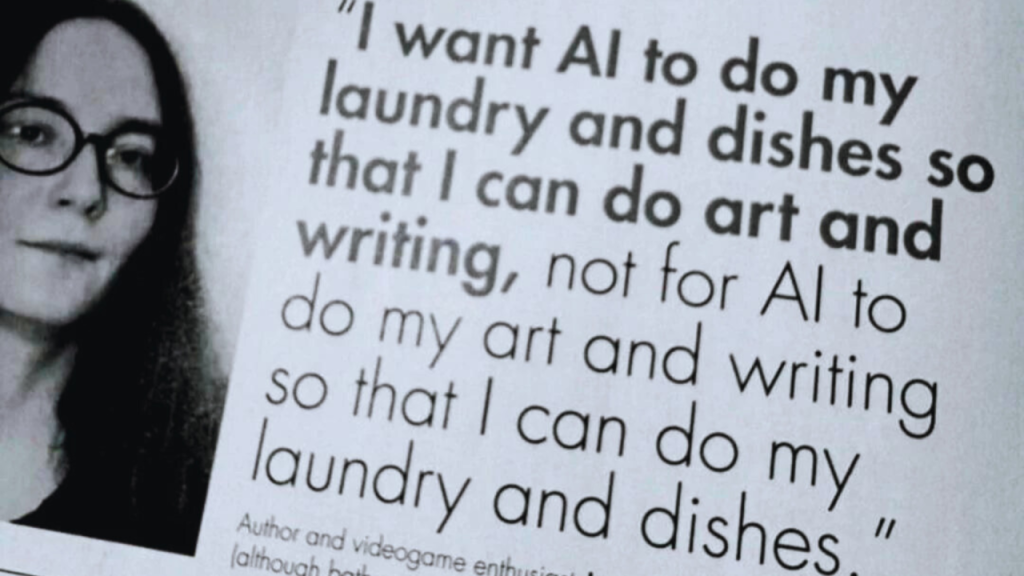
We don’t want AI to take away the creative part of our brain. At our core, being human is about curiosity and problem-solving in creative ways. I worry about AI removing this skill set.
I was recently watching a keynote speaker I admire present the BrickIt App as a positive AI tool and I couldn’t disagree more. Take a look.
I understand that it is a wonderful way of maximising resources and output, but that is not what play, imagination, discovery, and curiosity are about. It is about the journey, the ‘trial and error’, the ‘problem-solving’. It is about wonder and potential, about something emerging from nothing, the essence of creativity.
Teach Someone to Fish
Getting the technology to do all that for you erodes the development of these skills in Generation Beta. They are being handed a solution, the fish, instead of a fishing rod. They are being taught that their own ideas are not good enough. They are being given step-by-step instructions as opposed to learning problem solving. Trust me, this is not a good thing if you extrapolate this theory to society and Gen Beta as a whole.
Every industry and customer: brand connection will be touched by AI. The opportunities for more efficient and better customer connections are everywhere, far outweighing any fear you should have about AI stealing jobs or dumbing down society.
Invest early and keep an eye on the customer value proposition (so you don’t end up as the next Ballie). And remember, it is all about connection.
Just because a robot can technically give you a massage, it doesn’t mean it will be anything as enjoyable as a human, who is able to read the nuance of micro-body language. Connection isn’t just the physical.
This article is an excerpt from the Ken Hughes Keynote ‘AI, Data & Disruption’, one of the most popular keynotes on the international conference circuit on the consumer and brand impact of Artificial Intelligence.
This article was written while Ken was being massaged by a robot and attacked by a Ballie.