

I am typing this with one hand. My left arm is out of commission, having been spectacularly sheared from my shoulder two days ago. Broken clean through, the humeral head left in my shoulder like a lonely tennis ball waiting for a dog that went chasing a squirrel.
Apparently, the soonest theatre slot for the required reattachment surgery (plates, pins, etc.) is seven days away, so for a week I have a flat-pack IKEA arm – the pieces are all there but need putting together.
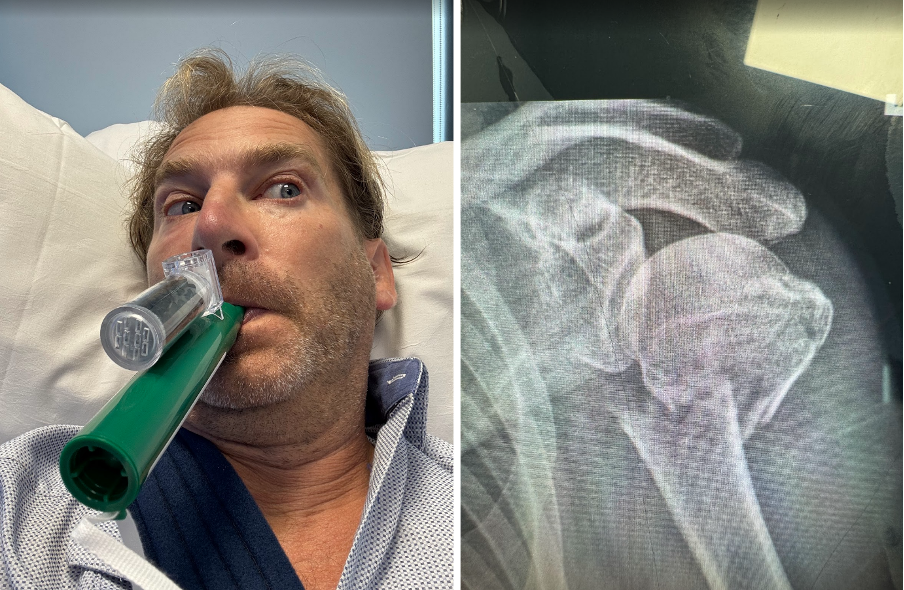
The pain, of course, is off the charts (those Penthrox green whistles are a Godsend). I guess it is to be expected. All the nerves are wondering what’s going on. Where’s the bone gone? (Side note – This article is being written on a lot of pain meds, so prepare for some tangential arguments and possible meanderings!).
‘Connection is Everything’.
The above phrase has become central to almost every keynote I deliver today. The irony that my arm is currently ‘disconnected’ skeletally does not escape me.

We live in a business world obsessed with customer experience, loyalty, customer lifetime value and advocacy. Yet, I increasingly find myself returning to the reality that the strongest relationships in our lives are rarely built during the easy moments. It is in pain we often ‘connect’.
Think about the people closest to you. Real relationships deepen when someone helps you through difficult times. It is the friend who drives across town at midnight because your car has broken down. The neighbour who quietly cuts your grass while you’re in hospital. The colleague who notices you’re struggling before you’ve even admitted it yourself, and simply gets on with helping. Pain has an extraordinary ability to reveal character.
In Customer Journey and Customer Experience (CX), we spend almost all our energy trying to eliminate friction and pain. We redesign our website to reduce clicks, shorten call waiting times, automate customer support, measure NPS and CSAT and map friction points with forensic precision. All those things matter, of course. Nobody enjoys unnecessary complexity. But in our determination to remove every bump in the road, perhaps we have overlooked one of the greatest opportunities for building genuine customer loyalty?

The reality is that pain is inevitable in life and in the customer: brand experience.
Sooner or later every customer relationship encounters difficulty. Flights are cancelled. Your air conditioning unit stops working. Your luggage disappears somewhere between Heathrow and Hawaii. The waiter gets your order wrong. Your broadband goes down. Real life has an unfortunate habit of ignoring the beautifully designed customer journey maps we spend months creating.
The question, therefore, isn’t whether your customers will experience pain, but what they will remember about your brand when they do.
Pain Exists to Protect Us
From an evolutionary perspective, pain is one of our smartest systems. Without the physical pain I am experiencing today, I would continue to use my damaged arm, causing further, and possibly irreversible, damage. Pain is important, critical communication.

There is an extraordinarily rare neurological condition called Congenital Insensitivity to Pain (CIP). People born with this genetic mutation cannot feel physical pain at all. While that might sound like a superpower, the reality is devastating. Children bite through their own tongues, broken bones go untreated because nothing hurts, and cuts or burns become life-threatening because the body never sends a warning signal.
Pain is never the problem. It is information. It exists to tell us that something requires our attention. In medical terms, pain is not the problem or disease; it is the messenger.
One of the fascinating parts of the physiology of pain is that emotional pain works in remarkably similar ways to physical pain.

Over the past two decades, social neuroscientists have demonstrated that experiences of rejection, exclusion and betrayal activate many of the same neural pathways associated with physical pain. Naomi Eisenberger’s work at UCLA famously showed that the anterior cingulate cortex, one of the brain regions involved in processing physical pain, also becomes active when we experience social rejection. That ‘knot in your stomach’ you feel when in emotional distress is not ‘all in your head’.
From an evolutionary perspective, this makes perfect sense. For our ancestors, being rejected by the tribe could be every bit as dangerous as suffering a physical injury. Isolation often meant starvation, vulnerability or death. Our brains therefore evolved to treat social pain with the same urgency as physical harm. Thousands of years later, that biology hasn’t changed very much.
When a brand lets us down, our response isn’t purely rational. We don’t simply calculate that a parcel arrived late or that our flight was delayed. We feel disappointed. Frustrated. Embarrassed. Sometimes even betrayed. In the past, I have written extensively about identity; brands being the ‘props in the theatre of the self’. When brands closely related to our sense of self let us down, those painful feelings are very real, and they can linger far longer than the inconvenience itself.
Why Bad Days Create Lasting Memories

Behavioural and trauma psychologists have spent decades exploring why negative experiences leave such a powerful imprint on memory.
Daniel Kahneman and Amos Tversky’s work on Loss Aversion demonstrated that losses are experienced far more intensely than equivalent gains. Losing €100 hurts considerably more than finding €100 feels good, and customer relationships work in much the same way.
Most of us can vividly remember the airline that stranded us overnight, the broadband provider who left us disconnected for days while working from home, or the hotel that somehow managed to lose our reservation despite the confirmation email sitting in our inbox.

Interestingly, we often remember something else as well. We remember what happened next. Did somebody care? Did anyone apologise? Did someone take ownership? Or were we simply handed another case number and politely informed that our complaint was ‘important to them’?
Pain magnifies emotion. Every painful customer moment therefore becomes a crossroads. It can deepen the relationship or quietly begin eroding it.
Relationships Are Built Through Repair
One of the most influential relationship researchers of the last fifty years is John Gottman. Having studied thousands of married couples over several decades, he reached a fascinating conclusion.

The happiest couples weren’t the ones who avoided conflict but the ones who became exceptionally good at repairing it.
Arguments happen. Misunderstandings and disappointments are inevitable. What distinguishes healthy relationships is not perfection, but recovery. Successful couples apologise, reassure, reconnect and demonstrate that the relationship matters more than winning the argument. Repair is where attachment grows, and the same principle applies beautifully to Customer Experience.
Brands often believe loyalty is built because everything worked perfectly, but that isn’t necessarily true. In many cases, loyalty is built because something went wrong and the organisation responded in a way that completely exceeded expectations.
Think about how many legendary customer service stories begin with failure.

The Ritz-Carlton guest who forgot his laptop or the family whose child’s favourite teddy bear was left behind on holiday. The BOL.com customer who had an entire trampoline park built in their back garden to apologise for the late delivery of the regular trampoline.
These stories begin with pain, but what makes them memorable and remarkable isn’t the problem; It is the response.
The Pain Pyramid
I think we’ve been looking at customer friction and pain through the wrong lens for years.
Instead of seeing pain purely as something to eliminate, perhaps we should recognise it for what it really is: an opportunity to strengthen attachment.
I think of it as The Pain Pyramid, a three-tiered model for transforming customer suffering into customer loyalty.
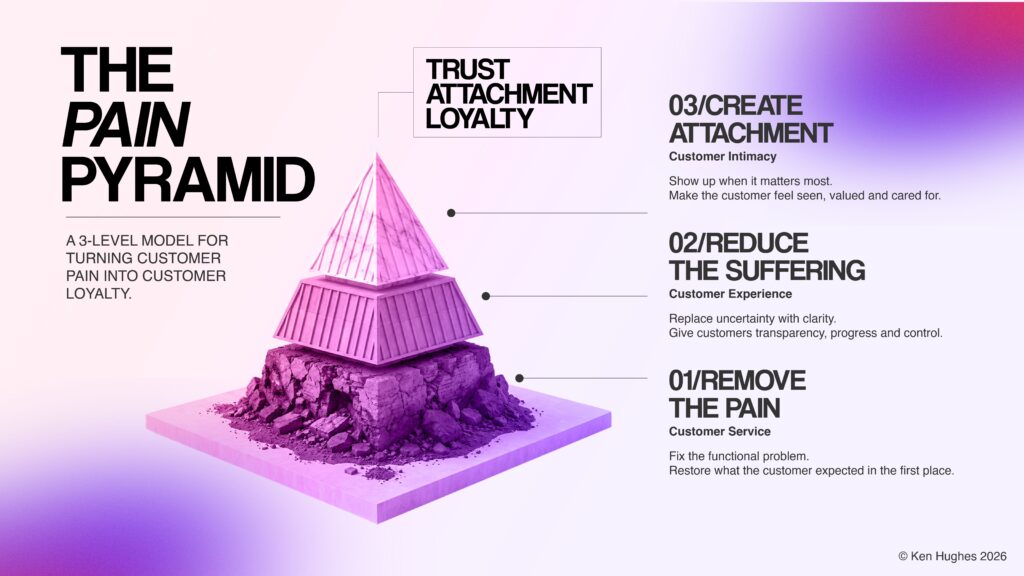
Level One: Remove the Pain
At the base of the pyramid sits Customer Service.
This is where organisations solve functional problems. The washing machine gets repaired. The flight is rebooked. The replacement product is shipped. The refund arrives.
Here, competence, efficiency and reliability matter. Without them, nothing else is possible.
But solving the problem simply returns the customer to where they expected to be in the first place. It is, to borrow a phrase I use regularly, your ticket-to-play.
Unfortunately, many organisations believe the journey ends here. It doesn’t. You’ve just reset the game.
Level Two: Reduce the Suffering

Pain is rarely caused solely by the problem itself. Much of our suffering comes from uncertainty.
When I first snapped that bone, I assumed my local private hospital would have me on the ‘next day’ surgery list. That is why we pay the expensive private healthcare premiums, right?
24 hours later, I found myself contacting a variety of orthopaedic consultants to get on their immediate surgery lists. The answers varied from ‘we are not taking on any new patients at this time’ to ‘current surgery waiting times are 2-3 weeks’. It is not the kind of uncertainty someone with a severed arm wants to hear.
Pain is magnified when we don’t know what happens next, when we don’t know who owns the issue, and when we don’t know whether anyone is actually working on it. (Side note – I did finally manage to get a surgery slot for 7-days post-accident, which is why I’m writing this today – trying to distract myself from both the physical pain and the agony of the wait).

Psychologists have repeatedly shown that uncertainty amplifies stress, even when the outcome itself isn’t ideal. Given a clear answer, humans adapt remarkably well. Left in limbo, however, our imaginations begin filling the gaps.
This is where Customer Experience comes into its own. Good CX isn’t simply about solving problems but about reducing suffering while the problem is being solved.
Domino’s understood this years ago with its pizza tracker. Rationally, knowing your pizza is “being prepared” doesn’t make it cook any faster. Psychologically, however, those updates replace uncertainty with progress. Every notification restores a little control.

A car insurance company once trialled a claim app that auto-deleted from the customer’s phone after 21 days. The underlying promise was that the claim would be filed, actioned and settled all in this timeframe, guaranteed. With a clear progress dashboard, it resulted in sky-high CSAT scores due to the certainty.
Even if the issue remains, suffering diminishes with transparency and certainty. My arm is still broken, but I feel better about it knowing the surgery is scheduled for next week.
Level Three: Create Attachment
The top of the pyramid is where Customer Intimacy begins, and sadly a level very few organisations ever reach.

Here, the goal is no longer simply fixing the issue or improving the journey but to demonstrate that the customer matters beyond the transaction itself.
HomeServe’s Mike Harrison perfectly illustrates this principle. After finding an elderly customer unconscious, he smashed a window to gain entry, performed CPR until paramedics arrived, repaired the toilet he’d originally been called out to fix, repaired the broken window he had smashed and later sent flowers to the hospital.
None of those actions appeared in his job description, but every one of them strengthened the relationship.
Similarly, specialist bereavement teams within banks understand that families dealing with the death of a loved one don’t simply need forms processed efficiently. They need compassion, patience and someone willing to shoulder part of the emotional burden during an extraordinarily difficult period.

This is no longer Customer Service or even Customer Experience. It is Customer Intimacy, fostering a sense of closeness during times of crisis.
AI Changes Everything… Except This
As Agentic AI rapidly transforms Customer Experience, organisations will become exceptionally good at preventing problems before they occur.
Predictive maintenance will stop machines failing. AI assistants will resolve issues instantly. Automation will remove huge amounts of friction from our everyday lives.
But while AI can remove inconvenience, it still struggles to replace genuine compassion. Algorithms can restore functionality, but they cannot yet restore hope. They cannot sit with someone who has just received devastating news. They cannot instinctively recognise when reassurance matters more than efficiency.

While the future of Customer Experience will undoubtedly become increasingly automated, the future of Customer Intimacy remains profoundly human.
The Pain Paradox
Perhaps the greatest irony in Customer Experience is that the moments organisations spend their lives trying to avoid are often the moments most capable of creating lasting loyalty.
Nobody wants their flight delayed, their boiler to break down or to have to make an insurance claim. But when those moments inevitably arrive, they become invitations.
Invitations to demonstrate competence, empathy and to demonstrate ‘brand character’.
Just as in our personal relationships, customers rarely remember us for the easy days. They remember how we behaved when life became difficult.

Customer Service removes the pain. Customer Experience reduces the suffering, but it is Customer Intimacy that creates the attachment.
Pain itself rarely destroys relationships. Abandonment does.
The organisations that understand this stop viewing complaints as failures and start recognising them for what they really are: moments of profound emotional opportunity. In those moments, customers stop asking whether your product works and start asking a much deeper question.
“Can I trust you to be there when I need you most?”
It is the question we all ask of our partners, and it is as critical in our customer relationships. Answer that question well enough, and you won’t simply have satisfied a customer. You’ll have built a deep, connected relationship.
Pain is a chisel. It is up to you to carve something beautiful from it.